Showing posts with label customs. Show all posts

Monday, December 07, 2009

Widders - Hands and Hearts

Widders are a strange sort of psuedo priest and hedge wizard combined, though no Widder would ever concede to such an identity. More so the Widders of veil see themselves as simple wisemen and women, possessed of an acumulated knowledge based on common sense and a straight forward view of the world around them.

The Widders function more on a level like a friendly neighbor and local healer/sage. They often know things that others do not, about their home and the valley as a whole. These secrets and valuable tidbits of knowledge are often handed down from one Widder to another as they are trained.

The wise ones' powers are nowhere near that of the priests and clerics of other lands but they are no less valuable to the rustic communities which they serve. On more than one occasion a community or lost traveller has owed their life to the capable and crafty hands and skills of the local Widder.


Wednesday, March 22, 2006

Poached Lark and Mushroom Pie - Food and Drink of The Valley of Baryn

Food is an important part of the human culture of Vale. Rustic and earthy folk, the men and women of the valley have discovered a number of delicacies among the native flora and fauna. most meals include a mixture of vegetables, fruits, nuts and usually one or two meat dishes but there are several noteworthy dishes besides the common steak or mutton chop.

One of these is the poaching of birds of all sorts. The Haelic folk of the Vale seem to have an affinity for the slow-cooking of all manner of avian life from small song birds as appetizers to larger foul. Such dishes are often served with sauces mixed from cream and berries or jelly glazes.

Boar meat is one of the most common of the wild meats served. The native species of boars range in flavor from the musky, gamey flesh of the Razortusk to the spicey, almost peppery meat of the Blunt-Tusked Cliff Boar. Boar meat is often served with a minimum of seasonings, the flavor of the meat allowed to express itself. Sides are offered along with the boar and usually take the form of complimentary nuts and vegetables, often roots and tubors.

Along the rivers, many types of fish are served. Among them are several forms of dangerous, predatory gars and pike, the sort that take challenge to catch, but the rarest and most dangerous is the Bull Eel - a seven foot long eel noted for the horn-like growths above its eyes. Bull Eel is served boiled and whole, all its organs intact and a single eel can feed an entire family.

Mushroom Pie is a favorite baked good, the forest of the valley offering several varieties of hearty, meaty fungus that bake into fragrent, juicy pastries and pies. Often, the mushrooms are mixed with other vegetables and sometimes grains and carried as provisions. One variety of mushroom called the Hearthstool is as big as a serving platter and is sometimes roasted whole or breaded and fried as a food to be enjoyed at social functions.

A special kind of honey is obtained from the Reaper Wasps of the deep forests and it's red-hued sweetness is prized both for its flavor and its reputation as a love potion. Obtaining this honey is dangerous as the solitary Reaper Wasps protect their nests and clutches of eggs with suicidal zeal.

In the South, in Bethalport and the surounding villages, many kinds of seafood are to be had. From Saber Muscles and Shallow Loach Fish, the variety there is great. Cove Octopi are often cultivated in tidal pens and harvested at about a year old when their heads measure the size of a large dog. Cape Perch and Sea Harps (a golden-colored seal) are hunted through the traditional means of harpooning as the struggle these beasts go through in being netted poisons the meat.

Much prized among the Brinefolk are the sholes of Moon Tarpin that gather in the Autumn months under the harvest moon. At this time the tarpin are lulled into a sort of languid stupor as they get their bearings for their upcoming migration to the mosre southerly waters. Huge hauls of Moon Tarpin are brought in by the Portlock fishing fleets during these months, often requiring the recruiting of extra hands to take full advantage. During this time though a special hazard also visits the coastal waters off Vale - the Abyss Shark.

Abyss Sharks are so-called for the fact that their black bodies absorb light, making them nearly impossible to spot in the nighttime waters. Many fishermen have found themselve the victim of a nearby Abyss Shark simply because the predator was unseeable in the hazey night. During the gathering of the Moon Tarpin, these sharks are at their most agressive, using the abundance of easy prey to stock up on food so that they may begin their bi-annual mating duels. Finding oneself in the midst of a pair of duelling Abyss sharks is the sort of thing that rare survivors care little to speak of.

There are more delicacies in the land of Vale, but space does not allow a full disclosure, but the variety and ingenious use of the valley's abundance never ceases to amaze visitors to this rustic land.

Bethalport - The Briney South of Vale

The southern tip of Vale is populated by a gritty seafaring folk known as the Brinefolk. These salty folk have long plied the coastal waters, making their home port the town of Bethalport, named for Bethal Bay where is resides.

Though they are of the same Haelic racial stock as the other men of Vale, the Brinefolk have developed a distinct subculture all their own. Identifying strongly with the sea from which they glean their livelihood, the Brinefolk have their set of superstitions and beliefs.

Brinefolk tend to live a slightly more afluent lifestyle, gaining a tidy, more regular income from the sea. So much is the difference between the average wealth of an "Uplander" and a Brineman, that Brinefolk are often lampooned as gold-hoarding sea captains or farcical pirates. This of course is far fro mthe truth and the colelction of wealth by Brinefolk is for good reason.

The life of a Brineman is frought with even more danger than that of an Uplander. In the valley there are animals and monsters, but on the coast and at sea there are the elements. An average fishing voyage brings with it high seas, horrible conditions and frequent accidents and disaster. Sea monsters and hostile raiders can also be found off the coast and many ships have returned to port less men they left with or without all together.

It is due to this danger, more than anything else, that the Brinefolk amass their wealth in lavish homes for if anythign should happen to her husbands, brothers, and sons a Brinefolk woman may have no other source of income than that which makes up her home and the coffers of her departed.

Bethalport is one of the closest things Vale has to a true city. Still more like a large town, Bethalport is home to several large families of sailors known as "Portlocks" for the control they hold over certain landing spots and fishing grounds. Infringing on a Portlock's fishing ground or trying to land or sell fish at his dock is grounds for a skirmish and few Brinemen are loath to lavish their ire on a transgressor. In Bethalport these Portlocks have formed large unions of boatsmen and porters.

The men and women of these Portlocks keep the trade flowing through Bethalport, offering warehouse space to tradesmen moving goods up and down the River Nor and in and out of the port to the sea. Incoming goods are taxed and outgoing goods are moved by the labor of the Portlocks for a fee, all adding to the pockets of the Brinemen. This can make goods coming into and out of Vale very expensive.

Primary exports through Bethalport are furs, woods, minerals and exotic meats found upland in the valley. imports are often food goods from across the sea or around the coast, luxury goods, cloth and manufactured goods. There is a disproportionate amount of imported goodsinto the valley as the spread-out communities of the upland peoples does not foster large-scale industry. Self-sufficient communities still find themselves in need of the occasional manufactured tool which is often obtained either by a trip to Bethalport or through a roving trader.

Brinemen often run ferries full of goods up the rivers full of goods to spread from the various riverside towns into the valley. These river boats are veritable floating forts with high walls, oars and sails and defensible towers.

Though they are different fro mtheir Upland brethren, the Brinemen of Bethalport are still Haelic ans share that people's disdain for organized religion, choosing to base their beliefs on elemental forces and spirits of nature. They do differ, however, in that they have placed a disproportionate amount of trust and faith in the spirit of the seas, an entity known as Nadu, or the Father of Seas and in a ghastly sea devil named Gon who fits the nearest thing that any Brineman or Uplander will ever know to an arch-fiend. The Widders of the Brinefolk or often salty, hermit-like figures, living in coastal cave and cliff-side shanties. Often looked on with a bit more fear than those of the uplands, these Brine Widders are seldom approached unless absolutely neccesary.

As has been mentioned, coastal threats come in all forms, but most notable are the marauders from under the sea, a race of fishmen known and the Locathah. These creatures, though not evil, have a bitter emnity toward the Brinemen who often blame them for fowled nets and lost catches, whether true or not. This has lead to skirmishes in the past and built the strained relations of today. Locathah and Brinemen seldom encounter each other without a violent exchange and often Locathah will attack isolated boats while Brinemen waste no opportunity to snare and strand fishmen in the blistering sun or crush settlement in the shallows with a calously layed anchor. though Bethalport itself seldom comes under attack fro mthe Locathah, the same is not true for other smaller fishing villages and coastal settlements and the result of such a raid can mean much damage to property and the loss of lives.

I can be said the coast of Vale is not a harsh land but it is not without its dangers, making the folk that dwell there a colorful and intense people.

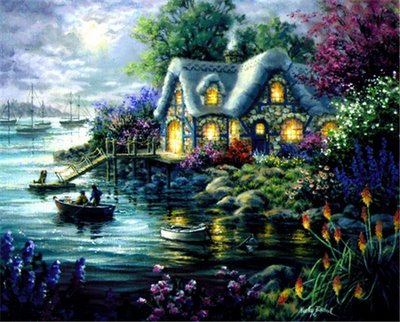
Hearth & Home - Dwellings in Vale


There is a saying in Vale, that sums up the view of the home. "Some walls, a roof and a door. Windows, chimney, rooms and floor. A home is all these things, but much much more."

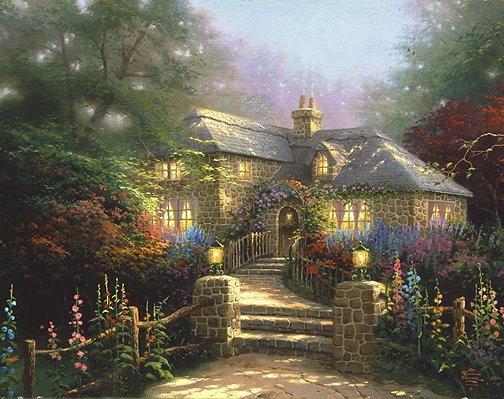
The Haelic folk that settled the valley brought with them their love of hearth and family and this can be seen in the care that they take in their homes. Though a great variety in homes can be found, determined by resources and means, the folk of Vale always do the best they can with what they have, often incorporating natural elements into structures to greater maximize what resources are available.

Central to any Haelic home is the main room and entry way known as the the "Halla" or "Portal Room". It is here that the majority of a Haelic family's homely assets will be focused. This is not for any petty sense of ego or need to display ones wealth but more for the simple fact that key to Haelic social structure is the open hopsitality that is paid to those that visit one's home. Guests to a home in Vale are treated to the best any family has, as long as such hospitality is not abused.

The second most important room in any Haelic home is the kitchen. Here the folk of Vale gather for meals, never straying too far from the place where the food is prepaired to consume it. It is thought that the closer one comes to the act of preparing the food, the more nourishing it will be to both body and spirit. For this reason, any mother or daughter in Vale will spend an amazing amount of time making sure that even the most meager of meals is given the utmost care and attention so that her family will have the most nourishing meal possible.

Such meals are rewarded with adoration and compliments from families and to forget to do so is the utmost in rudeness. No Haelic father or son of Vale would dare forget to thank his mothers, sisters or daughters for the hard work they put into making sure his table was the most grand it could be. It is not uncommon for The men of a house to clean up following a meal while their women take advantage of a moment's restand enjoy a warm drink and pleasant conversation while the meal is cleaned up.

Sleeping arrangements are often the most spartan of accomidations in Vale. This is not to say that they are not comfortable, but as they are for sleeping they are not given as great a priority as other areas of the home. Beds are often lined with comfortable down feathers or beaten straw or bowers, changed regularly. Blankets are woven from heavy whools from local sheep and goats or stitched together from softened hides and filled with more down or straw. Husbands and wives sleep together, often in the company of small children, while oder children and unmarried relations (sisters, cousins, aunts, in-laws, etc) share rooms usually no more than three to a room or as space allows. Where rooms are shared, each occupant sleeps in a pseronal set of sleeping wear and shares their space comfortably with others.

Accomidations for the privy are usually attached to the home by an interior door and a ditch that runs to a local stream or collection point. It is too dangerous in most places to have seperate privy facilities unless absolutely required by available drainage or some such. In households that require exterior trips to the facilities, there is often and a special light called a "Drungklaf" or "Pot Dagger" which can only be described as a cunning cross between a utility knife and a candle-holder. This device can be used to cut strips of fabric or leaves for cleaning or to fend off an angry beast in the dark fo the night.

All in all, the homes of the valley are best known for their warmth and inviting use of color. Pastel pigmants taken from local plants and minerals often make the homes seem to blend into their surroundings. It can be said that even the poorest folk in Vale live in better surroundings than some of the more well-off sorts in otherl ands.


Sunday, November 20, 2005

Wintermeet - Celebration of Winter Solstice

In the wilderness of the valley, the human people have found ways to keep themselves connected to their neighbors. Central to their Winter festivities is the celebration of Wintermeet. Originally just a mid-winter trade gathering, it has grown over time, into a holiday in its own rite. Marked by family and community gatherings, feasts and general festivities, the holiday of Wintermeet is celebrated on the Winter Solstice before travel becomes too perilous and most settlements are locked by snow, ice and cold-savaged beasts.


Wintermeet has been "glorified" further by the inclusion of the elves in its observance, adding a sense of magic, wonder and splendor. During the first night of the holiday's seven day observance, hopeful children waits by their windows, eager for a glimpse of the elves' midnight procession - a display of magic and pageantry specifically for the purpose of the holiday.

Though the festivities of Wintermeet are marked with feasting, games, stories and the exchange of goods and gifts, trade also occurs during these gatherings. It is not uncommon, however, for a certain generosity to be extended to those who may not be able to afford the asking price. The elves, who will have arrived during the dark hours will have set up a wonderful gift display for the community they are visiting,always seeming to include those things most needed by the folk of the settlement or township.

Festivities continue for a full three days and then the various families and groups part company in a final twilight feast, usually enjoyed in the brisk outdoor air, warmed by roaring fires and elven magic. It is not uncommon for some of the elves to escort their human friends through the cold winter wilderness to the safety of their homes.

Way Inns - The Travellers' Resting Place


In the sparsely populated Valley of Baryn, a traveler can often find himself cut off from any civilization for days, perhaps even weeks at a time. In answer to this, the people of Vale have established an institution known as the Way Inn. Way Inns are large inns, far beyond your local rest spot. Nearly a settlement in their own rite they offer accommodations beyond simple room and board, often keeping at least a blacksmith and often a tailor and/or outfitter or other services on hand. Though many of these Way Inns are family establishments, some are cooperative ventures between local craftsmen and traders.

Though each Way Inn is different and varies in size from a single large building, to several buildings standing in a cluster, and all the way to a full enclosed collection of building, protected by a defensive wall (mainly in troubled spots and near the mountains' edge), they all have a few things in common. Catering to weary travelers, they all make an attempt to satisfy the needs of travelers who may have been away from home for a long time. To this end, simple things such as baths, good food, comfortable beds, strong drink and friendly service are a must. Most Way Inns have a staff of dozens including many cooks, servants, a talented hunter (responsible for finding the finest game) and no small number of armed wardens.

As has been mentioned, other services are often available, either by specific intent by the inn's owner or as a proxy business or cooperative venture developed in partnership with the inn. One constant among these services is blacksmiths who know that such inns are a sure place to find work repairing wheels, armor, weapons and other common wares. Bower and fletching services are also commonly available as most way inns have a huntsman on hand or retainer who is glad to earn the extra coin. Less common but by no means infrequent are such services as healers, apothecaries, even scribes or map makers. Also available, mostly near the mountains, are assayers and money changers. In some cases a chapel will be attached to the Way Inn which may provide any of these services through the clergy there.

Way Inns can be vulnerable at times, due to their isolation and the small number of people living at their locations. Even the best defended Way Inn is no match for anything greater than a small raiding force. Most Way Inns greatly rely on hired help or the assistance of local wardens or wandering rangers, but such assistance is sporadic. As such, a Way Inn usually keeps a good network of informants and scouts on retainer to help them predict when a threat may be nearing and so take appropriate action. Such tasks are a good source of income for wandering warriors, sell-swords or adventurers between quests.

Way Inns are an institution in Vale and there are some that have reached a certain level of renown through reputation or in some cases, such as the Willow Brook Inn, through song and tale. Such inns are usually much more frequented than others due to their fame and can rely on more aid than others.